A disabled one-ton pickup needs more planning than its badge suggests. If you’re searching for a “1 ton dually tow truck near me,” dispatch needs the truck’s actual configuration, condition, cargo, and location before referring the job.
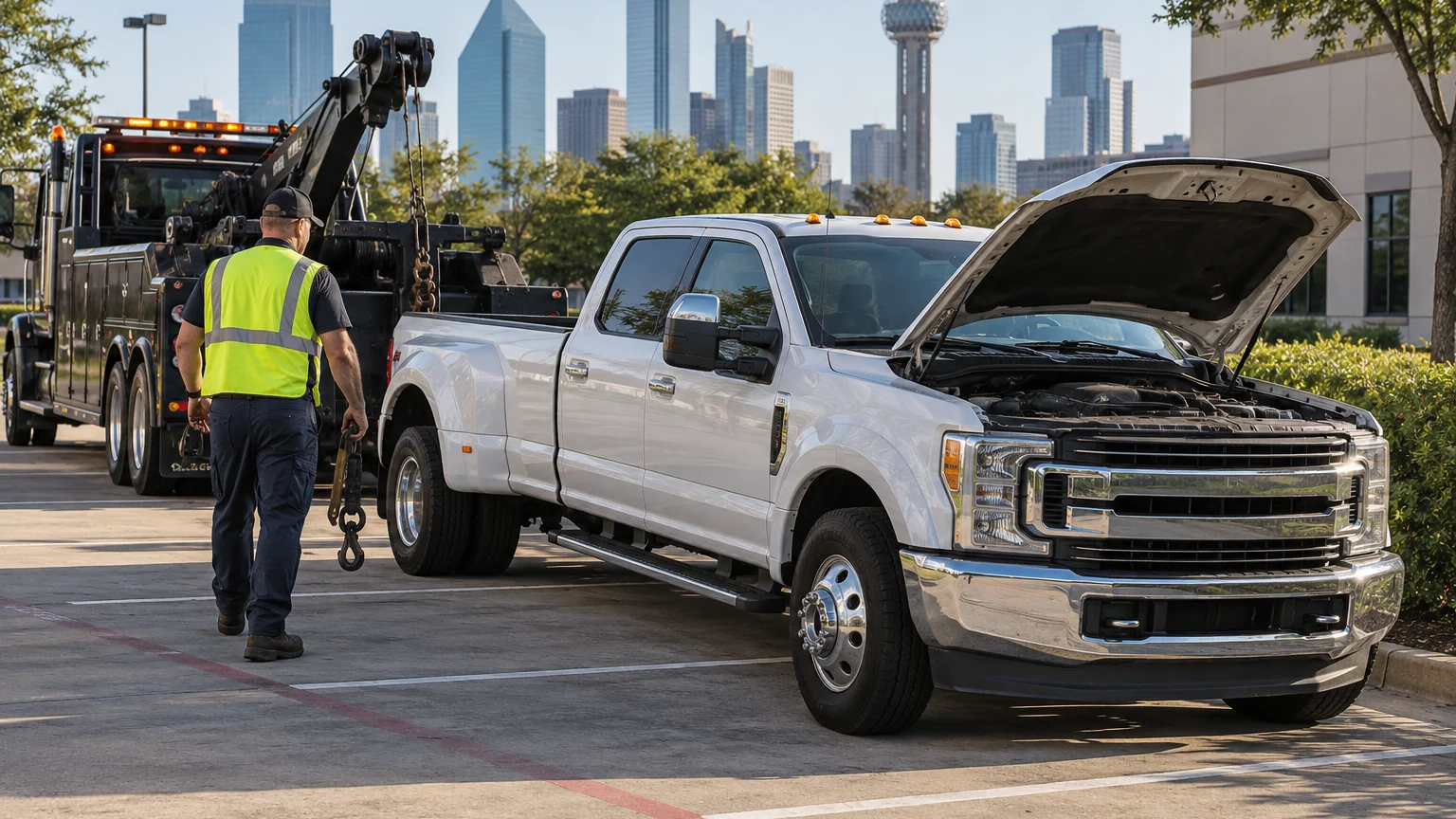
Quick Tow Dallas connects callers with licensed, insured towing operators. We don’t own tow trucks or choose equipment for the operator. The operator reviews your details, confirms capability, and sets the price before rolling.
Identify the pickup and its configuration
Start with the year, make, model, and exact configuration. “One-ton” and “dually” help describe the pickup, but neither gives dispatch a complete towing profile.
Tell us whether the truck has two or four doors. Include the bed length if you know it. Say whether it has rear dual wheels, four-wheel drive, or an altered suspension. Mention any service body, utility body, flatbed conversion, or other body fitted behind the cab.
A pickup that looks standard from the front may be very different behind the doors. Tool compartments, welding equipment, auxiliary tanks, and permanently mounted machinery can change the job. Don’t remove or estimate anything while standing beside traffic. Just describe what you can see and what the vehicle documents show.
Photos can help an operator review the configuration. Useful views include the full driver’s side, full passenger side, front, rear, and disabled area. Include the wheels and anything mounted above or behind the cab. Keep license plates and personal documents out of shared images when possible.
The pickup’s drivetrain also matters. If you aren’t sure, check the owner’s manual, vehicle documents, or manufacturer information. Don’t guess based on trim badges.
This narrow vehicle detail is why general heavy-duty towing guidance for Dallas can’t settle every pickup request. A work pickup near I-35E in Stemmons may need different access planning than one inside a North Dallas parking garage. Dispatch needs the actual vehicle and location, not just a category.
Share the vehicle specifications from reliable documents
Use the pickup’s documents and manufacturer information when sharing specifications. Don’t estimate weight, dimensions, or towing needs from the vehicle’s nickname.
Start with the vehicle identification number if the operator requests it. Then look for the manufacturer’s labels and the owner’s manual. Registration or fleet records may also identify the exact model and configuration. A fleet manager might have build documents for an upfitted work truck.
Read the information exactly as shown. Don’t substitute a similar pickup’s specifications. Two trucks with the same model name may have different bodies, drivetrains, wheel arrangements, or installed equipment.
If you can’t confirm a specification, say that it’s unknown. An honest gap gives the operator a reason to investigate. A guessed figure can send the request in the wrong direction.
Dispatch also needs the truck’s approximate overall length and height when those details are documented. Height becomes especially relevant in garages, loading areas, and covered service bays. Tell us about ladder racks, light bars, exhaust stacks, cranes, or equipment extending above the cab.
Quick Tow Dallas can route a request through its heavy-duty towing network, but the receiving operator decides whether the available equipment fits the job. We don’t determine that from a model badge.
Texas regulates towing operators through the Texas Department of Licensing and Regulation. Before handing over your keys, you can check an operator through the TDLR license search. The customer contracts directly with the operator who accepts and performs the tow.
Describe cargo, attachments, and wheel condition
Cargo and attachments can be as important as the pickup itself. Tell dispatch what’s in the bed, inside mounted compartments, and attached to the truck.
Describe toolboxes, tanks, generators, compressors, welders, cranes, racks, and loose materials. Don’t call the bed empty if fixed equipment remains installed. If the pickup carries work materials, say whether they’re secured, loose, leaking, or shifted toward one side.
Tell us about anything connected at the rear. That includes a conventional trailer, fifth-wheel trailer, gooseneck trailer, hitch-mounted carrier, or other attachment. Don’t assume the pickup and trailer can move as one job. The operator must review both units and decide what can be accepted.
Have separate details ready for an attached trailer. Share its type, condition, cargo status, and access. Our guide to RV and trailer towing dispatch details explains why the connected unit needs its own description.
Next, report the condition of every wheel and tire. Tell dispatch about missing wheels, flat tires, broken steering parts, damaged suspension, locked wheels, or a rear axle that appears displaced. Say whether the steering wheel turns and whether the transmission can shift. If you don’t know, don’t test a damaged vehicle just to answer.
Mention collision damage, leaking fluids, fire damage, or deployed airbags. Identify loose bumpers, steps, body panels, and equipment that could move during loading. Don’t crawl under the pickup to inspect it.
A flatbed towing request may be worth discussing when the truck has wheel, steering, or drivetrain concerns. Still, the operator must choose the towing method after reviewing the complete vehicle. A dually badge alone doesn’t make that decision.
Explain the pickup point and destination access
Give dispatch two complete locations: where the pickup sits and where it needs to go. A street address alone may not explain how the operator can reach either vehicle position.
In Dallas, name the road, direction of travel, nearest cross street, and visible landmark. Specify whether you’re on the main lanes, frontage road, ramp, parking lot, loading dock, alley, garage, or private drive.
The road network changes the approach. A pickup on I-635 near the High Five isn’t the same access problem as one inside an Oak Cliff repair yard. I-30 through East Dallas, US-75 through North Dallas, and Loop 12 near Irving each create different approach details. Give the operator the precise location instead of relying on a broad neighborhood name.
Say whether the truck is on pavement, gravel, mud, grass, a slope, or uneven ground. Mention gates, medians, low branches, tight turns, parked vehicles, and overhead clearance. If there’s a gate, tell dispatch how the operator will obtain authorized access. Don’t promise that a property manager will open it unless you’ve confirmed that directly.
For a parking garage, provide the posted clearance if you can read it. Note the level, entrance, exit, turn width, and whether the disabled pickup can roll. For a commercial property, identify the correct entrance and any loading restrictions communicated by the property.
The destination needs the same care. A repair shop near Downtown Dallas may have a different receiving entrance than its customer entrance. A home in the Park Cities may have limited curb space. A fleet yard in Garland or Richardson may require gate coordination.
Confirm that someone at the destination expects the pickup. Share any instructions directly with the accepting operator. This prevents a workable pickup from becoming a blocked delivery.
What the operator confirms before accepting the tow
The operator reviews the request before accepting it. That review should cover the pickup, installed equipment, cargo, wheel condition, access, destination, and towing method.
Be ready to repeat the truck’s year, make, model, and configuration. Provide verified specifications when requested. Tell the operator which details came from vehicle documents and which remain unknown.
The operator may ask for current photos. Send clear, recent images rather than older pictures of the truck. Damage, cargo, and ground conditions can change what the operator sees.
Ask the operator to confirm these points before rolling:
- The operator understands the full vehicle configuration.
- Attached trailers or equipment were disclosed.
- Cargo and fixed equipment were described accurately.
- Wheel, steering, suspension, and collision damage were reported.
- Pickup and destination access were reviewed.
- The operator has accepted the requested route and destination.
- The operator has set and quoted the price.
- Any information still needed has been identified.
Quick Tow Dallas doesn’t set the operator’s price. Confirm the amount and payment terms directly with the operator before dispatch. Don’t rely on a general online estimate or another company’s rate.
Ask the operator for an arrival estimate, since traffic and availability can change. Dallas congestion around the Mixmaster, I-35E, I-30, and I-635 can affect the trip. We don’t promise an arrival window.
You can also review the TDLR towing consumer information before the pickup. Keep the accepting operator’s company details and the agreed destination available.
Accurate intake protects the whole handoff. It helps dispatch find an operator willing to review the job. It also lets that operator decide capability using the truck’s real condition, not assumptions attached to “one-ton” or “dually.”
When to call us
Call when a one-ton or dually pickup is disabled, damaged, or needs transport by a licensed towing professional. Have the vehicle documents, cargo details, photos, pickup access, and destination ready.
Call us at (469) 902-4411 and we’ll connect you with an operator who handles this work.