A disabled car doesn’t always need the first available truck. Its drivetrain, wheel condition, clearance, and location can make a flatbed tow truck the better request.
The operator still needs to confirm the equipment before dispatch. Give clear details during intake, especially around Dallas garages and narrow streets.
How a flatbed carries the whole vehicle
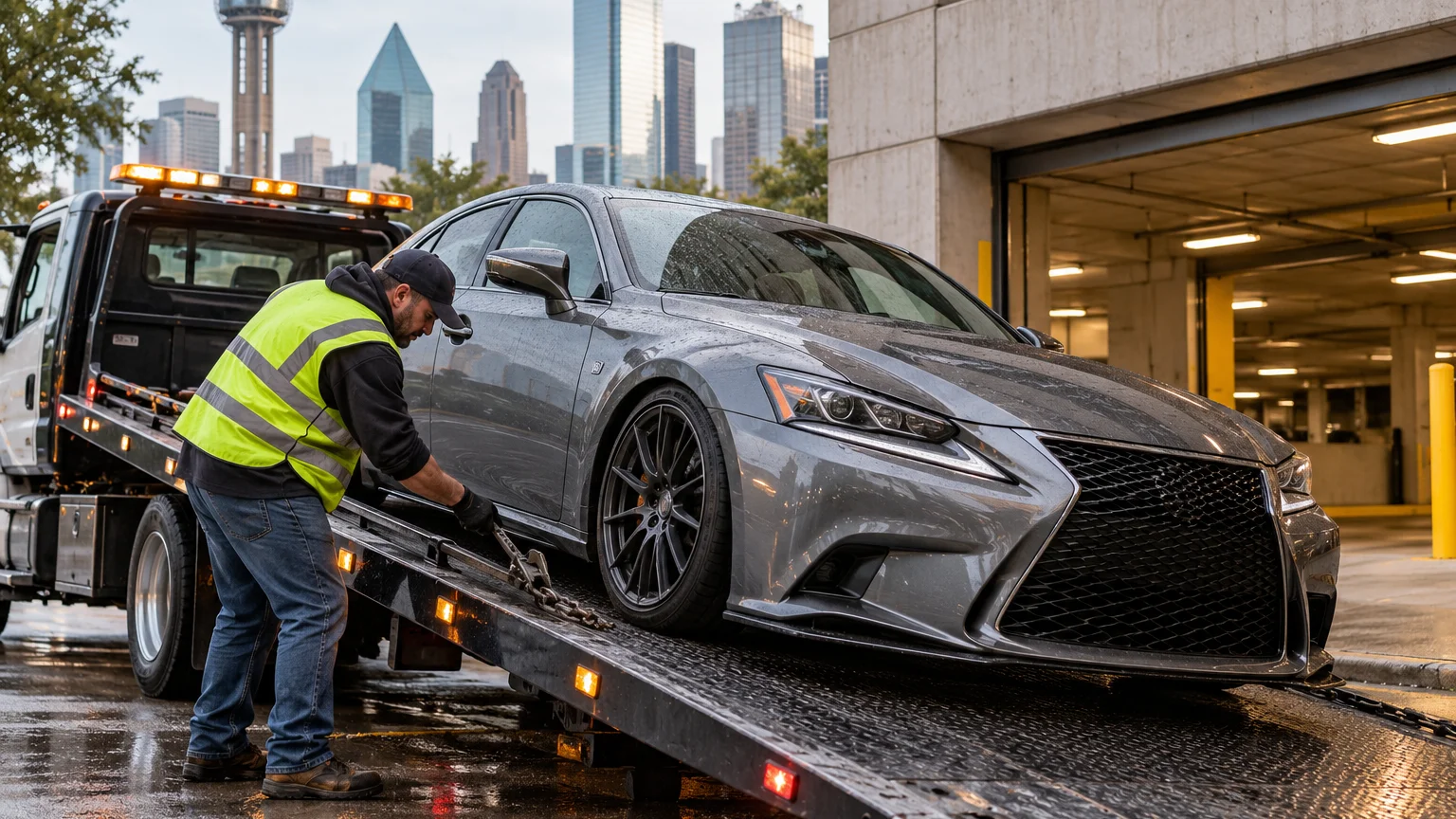
A flatbed towing truck has a platform that carries the vehicle during transport. The operator positions the vehicle on that platform and secures it for the trip. The car doesn’t travel with one axle rolling along the pavement.
That basic setup matters when rolling wheels could create a problem. It can also help when a vehicle has limited ground clearance or visible damage. The operator decides whether the vehicle can be loaded safely in its current condition.
A flatbed isn’t automatically required for every disabled car. The right choice depends on the vehicle, its condition, and the pickup location. A standard sedan with freely rolling wheels presents a different situation than a damaged coupe sitting low on a US 75 access road.
Start by describing what happened. Say whether the car stalled, lost a tire, struck something, or stopped after a warning appeared. Mention any leaking fluid, loose body panel, or wheel sitting at an unusual angle.
Quick Tow Dallas doesn’t own or operate tow trucks. We dispatch calls to licensed, insured operators who choose equipment for the job. Our flatbed towing service page explains how that referral process works.
If you’re deciding between a tow truck flatbed and another setup, read our wheel-lift versus flatbed comparison. That guide compares equipment types. This page focuses on the vehicle details that should drive the decision.
Vehicle condition and clearance details to share
Good dispatch starts with a precise vehicle description. Give the year, make, and model first. Share the drivetrain if you know it, but don’t guess. The operator can check the correct loading approach for that vehicle.
Next, describe the wheels and tires. Tell dispatch if a tire is flat, missing, or separated from the rim. Mention a locked wheel, damaged suspension, or steering that won’t respond. If the wheels won’t roll, say that before a truck is assigned.
Ground clearance also matters. Tell us if the car has been lowered or has a low front splitter. Mention side skirts, aftermarket bodywork, or loose panels. Photos can help the operator understand the condition, but they don’t replace an on-site assessment.
The vehicle’s position adds another layer. A car parked straight on level pavement differs from one angled against a curb. In Deep Ellum, parked vehicles and narrow street access may limit how a truck can line up. Along a US 75 access road, traffic position and surrounding space create different constraints.
Share these details during intake:
- Year, make, and model
- Drivetrain, if known
- Current wheel and tire condition
- Steering or suspension damage
- Visible leaks or loose bodywork
- Approximate ground clearance concerns
- Whether the vehicle is in park, neutral, or unknown
- Nearby walls, gates, curbs, traffic, or height limits
- Pickup and destination locations
Describe only what you can see. The operator can assess the remaining details after arrival.
AWD, low-clearance, and damaged vehicles
All-wheel-drive vehicles deserve a careful equipment discussion. Don’t assume every AWD model has the same towing instructions. Give the exact year, make, and model so the operator can confirm the suitable method.
Electric vehicles need the same model-specific care. Battery location, wheel condition, and manufacturer guidance may affect loading. Our guide to Tesla and EV flatbed towing in Dallas covers the details worth sharing for those vehicles.
Low-clearance cars can present another issue. The platform approach must account for the front bumper, underbody, and any aftermarket pieces. Tell dispatch if the car scrapes on ordinary driveway slopes. That detail gives the operator useful context before selecting equipment.
Visible collision damage changes the conversation again. A wheel may look straight while nearby suspension or body parts are damaged. A bumper, exhaust component, or underbody panel may also hang below its usual position. Report what you see without trying to pull anything free.
Classic and exotic cars may need extra planning because of their condition, clearance, or bodywork. They don’t automatically require one towing method in every situation. The operator should confirm the plan for the particular vehicle. See our exotic and classic vehicle towing service for the intake details we request.
When calling, avoid saying only that the car “won’t move.” Explain whether the engine starts, the transmission shifts, and the wheels turn. If you don’t know, say so. An honest unknown is more useful than a guess that sends unsuitable equipment.
Garage access can change the available truck
The right vehicle condition doesn’t guarantee that a flatbed can reach the car. Building access may determine which truck can approach and how the recovery begins.
This issue comes up often in Uptown garages. A disabled car may sit under a low ceiling, around a tight turn, or beside a concrete column. Entrance clearance is only part of the picture. Interior ramps, hanging signs, gate arms, and turning space may also affect access.
Before dispatch, look for a posted height limit near the entrance. Share the exact wording if you can read it safely. Also explain which level holds the vehicle and whether it faces into a wall. Note any locked gate or access card requirement.
Don’t promise that a property manager will admit a large vehicle. If building staff control entry, contact them and confirm the access process. The towing operator still decides whether the available space supports the proposed equipment.
A garage recovery may require a different first step before the vehicle reaches open pavement. That doesn’t mean a flatbed is unnecessary for the final transport. It means the operator needs the full access picture before choosing the approach.
Street pickups have their own constraints. Deep Ellum can present narrow curb space and busy blocks. Downtown loading zones may offer little alignment room. US 75 access roads create a different setting, with moving traffic and limited shoulder space. Tell dispatch where the car sits relative to travel lanes, ramps, and nearby driveways.
Let the operator control positioning once on scene.
What the operator must confirm before dispatch
The operator should confirm the vehicle details, pickup setting, destination, equipment choice, and price before rolling. Ask who sets the charge and what information the quote covers. Quick Tow Dallas doesn’t set towing prices, and we don’t publish a brand rate.
For a 30-mile tow, no verified brand figure is available. Distance alone doesn’t establish a price. Give both addresses and ask the assigned operator to state the price before dispatch. Don’t rely on an online average that may describe another city or a different towing situation.
The operator also needs to know whether the request is a consent tow or a non-consent tow. Government caps apply to non-consent towing, not as Quick Tow Dallas prices. Dallas City Code 48A-43 lists maximum non-consent tow charges by vehicle weight. The caps are $165 for vehicles at or below 10,000 pounds GVWR, $300 above 10,000 pounds through 24,999 pounds, and $489 per unit above 25,000 pounds, with a $978 maximum. You can review the Dallas City Code.
Operator licensing matters too. Texas towing companies and operators are regulated by the Texas Department of Licensing and Regulation. You can verify a license through TDLR before handing over your keys.
Whether a particular rollback driver needs a commercial driver’s license couldn’t be confirmed from the approved towing sources for this page. Truck classification and driver-license questions should be checked with the responsible Texas authority. A customer should still verify the towing operator through TDLR.
Before ending the call, repeat the vehicle model, wheel condition, garage limits, pickup point, and destination. Ask the operator for an arrival estimate, since Quick Tow Dallas can’t promise one.
When to call us
Call when damage, drivetrain, low clearance, or limited access makes equipment choice uncertain. A licensed towing operator should assess the vehicle and confirm the loading plan.
Call us at (469) 902-4411 and we’ll connect you with an operator who handles this work.