A stalled car near I-35E needs a different approach than one parked off Josey Lane. When you request roadside assistance in Carrollton, clear details help dispatch find an operator suited to your location and problem.
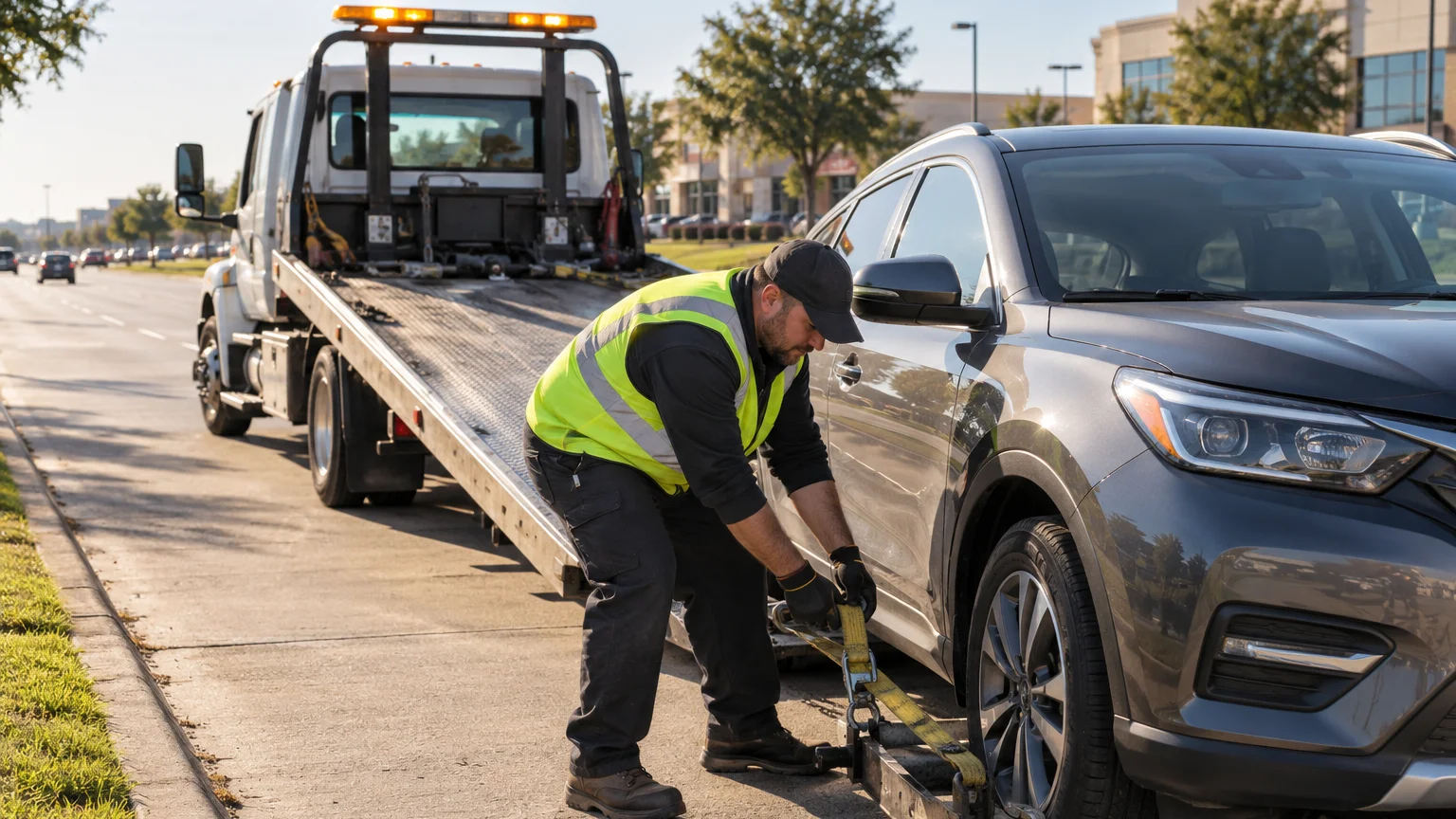
Quick Tow Dallas is a dispatch and referral service. We connect callers with licensed, insured operators who provide roadside assistance. The operator performs the work, sets the price, and contracts directly with you.
Give dispatch an exact location and safe access point
Start with where the vehicle is physically sitting. A Carrollton mailing address alone may not show which entrance, shoulder, garage level, or parking row the operator needs.
Share the street address when one is visible. Add the nearest cross street, business entrance, or recognizable landmark. If you’re near Belt Line Road and Josey Lane, say which road you’re on and which direction you were traveling. A map pin can help, but describe the setting too. Pins sometimes land behind buildings or along the wrong side of a divided road.
Near I-35E, give the direction of travel and the last exit you passed. State whether you’re on the main lanes, a frontage road, an exit ramp, or nearby private property. Don’t describe every location near the interstate as “on I-35E.” That can send an operator toward the wrong access point.
Use the same detail near the President George Bush Turnpike. Tell dispatch whether the vehicle is on the turnpike, an entrance or exit ramp, a frontage road, or a connecting street. Don’t guess about tollway procedures. Dispatch and the operator can decide whether the call can be accepted based on the location you provide.
For parking lots, identify the property and closest entrance. Add a store name, building number, row marker, or garage level when available. Mention gates, height restrictions, locked entrances, or parking validation requirements.
Stay where you can communicate with dispatch, if doing so is safe. If you relocate away from the vehicle, tell dispatch where you’ll meet the operator. Our broader guide to finding roadside assistance near Dallas explains why location details matter across the metro.
Describe the symptoms without guessing at the repair
Tell dispatch what happened, what you observed, and what the vehicle does now. You don’t need to diagnose the failure.
Useful details include whether the engine turns over, whether the lights work, and whether a tire looks damaged. Mention warning lights, smoke, leaking fluid, unusual sounds, or a strong odor. State whether the vehicle can shift into neutral, steer, or roll. Don’t attempt those actions if the location makes them unsafe.
For a tire problem, explain which tire is affected. Say whether it’s flat, shredded, off the rim, or visibly damaged. Tell dispatch whether you have a spare, but don’t promise that it fits or is usable. Our flat-tire roadside assistance guide covers the details an operator may request.
For a battery concern, report what happens when you turn the key or press the start button. “The dashboard lights come on, but the engine doesn’t turn” is more useful than “the battery is dead.” The cause could be something else, so let the operator assess the request.
Dispatch also needs the vehicle’s year, make, model, color, and approximate size. Mention whether it’s a car, pickup, van, motorcycle, or another vehicle type. Report modifications, low clearance, damaged wheels, or collision damage. Those facts can affect whether roadside help is appropriate.
Quick Tow Dallas doesn’t diagnose vehicles or perform repairs. We use your description to route the request. The operator then confirms what service may be available and whether the call fits their capabilities.
Highway shoulders and parking lots need different access
A roadside request on an I-35E shoulder isn’t the same as a disabled car outside a Belt Line Road business. Access conditions shape what the operator needs to know before accepting the call.
On a highway or ramp, describe the shoulder’s position and available space. Tell dispatch whether the vehicle is fully outside a travel lane. Mention barriers, narrow shoulders, construction, collision debris, or poor visibility. Don’t leave out a detail because you think it sounds minor. The operator needs an honest picture of the scene.
Near the President George Bush Turnpike, specify the road segment and direction. Share the nearest exit, cross street, or visible marker. A Josey Lane reference isn’t enough if you don’t say whether you’re north or south of the turnpike.
A commercial parking lot usually has different concerns. Tell dispatch whether the operator can enter directly from the street. Report gates, loading zones, garage ramps, tight turns, or posted restrictions. If the vehicle is underground or beneath a low structure, say so before dispatch.
Apartment properties can also require access instructions. Provide the building number, gate instructions, and parking location. Make sure the operator can legally reach the vehicle. Quick Tow Dallas doesn’t control private-property access, and it can’t authorize entry for you.
Don’t move the vehicle merely to make the description simpler. Give dispatch its actual position. If the scene changes after the call, contact us with the updated location.
For a dangerous or obstructed scene that roadside service can’t address, the request may need emergency towing. Dispatch can route the information, but the operator decides whether to accept the job.
Know when the request may need to become a tow
Some calls begin as roadside help and become towing requests. That doesn’t mean the original description was wrong. It means the vehicle can’t be returned to usable condition through the service the operator can provide at that location.
A missing spare can change a tire request. Wheel damage may also prevent a simple tire change. A suspected battery problem may continue after an attempted jump. Collision damage, leaking fluid, steering trouble, or a vehicle that won’t shift may also point toward towing.
Tell dispatch where you’d want the vehicle taken if towing becomes necessary. You don’t need a final destination before making the first call, but having one can reduce confusion. A repair shop’s name and full street address are better than “the mechanic near Josey.”
Confirm that the destination can receive the vehicle. Quick Tow Dallas can’t confirm a shop’s hours, acceptance policies, or after-hours drop procedure. Contact the destination directly when those details matter.
Don’t ask the operator to perform work that wasn’t described during intake. If the symptoms or destination change, say so. A roadside operator may not accept every towing request, and a tow operator may need information that wasn’t relevant to the original service.
Price can also change when the requested work changes. Quick Tow Dallas doesn’t set the price. The operator sets and quotes it. Ask the operator to confirm the service and price before the truck rolls, then ask again if the job changes from roadside assistance to towing.
If the car can’t be moved through roadside service, our emergency towing service page explains how dispatch handles a towing request.
What the operator confirms before accepting the call
The operator reviews the location, vehicle, symptoms, access, and requested service. They may ask follow-up questions before accepting the call.
Expect to confirm:
- Your name and callback number
- The vehicle’s year, make, model, and color
- The exact location and direction of travel
- Whether the vehicle blocks a travel lane
- The symptoms you observed
- Parking, gate, garage, or shoulder access
- Whether passengers or pets are present
- The requested service or towing destination
Answer with what you know. Say when you’re unsure. A clear “I can’t confirm that” is better than a guess about the vehicle or location.
The operator also confirms whether they handle the requested work. Don’t assume every operator carries every tool, serves every vehicle type, or can enter every property. Those capabilities weren’t confirmed for all network operators.
Before handing over your keys, you can check an operator through the TDLR license search. Texas towing operator and company licenses are administered by the Texas Department of Licensing and Regulation. TDLR also publishes consumer information about towing.
Ask the operator for an arrival estimate. Conditions, distance, access, and operator availability can affect it, so Quick Tow Dallas doesn’t promise a response window.
Confirm the operator’s quoted price before the truck rolls. If the requested service changes, confirm the updated scope and price directly with that operator. For a shorter intake checklist, see our guide to Dallas roadside dispatch details.
When to call us
Call when a vehicle in Carrollton needs roadside help or a licensed towing operator. Share the location, vehicle, symptoms, and access details so we can route the request correctly. Call us at (469) 902-4411 and we’ll connect you with an operator who handles this work.